

Why dogs want to sleep with their owners: Dogs often sleep beside their owners because of social attachment, comfort, warmth, familiarity, and routine. Sleeping together does not necessarily mean a dog lacks independence. The key difference is whether the dog can remain calm and relaxed when separated from its owner.
DoggyZine.com
If your dog insists on sleeping beside you, climbs onto your bed every night, or follows you into the bedroom, the behavior is usually related to social attachment, safety, warmth, routine, and learned comfort. Dogs are highly social animals, and research shows that many companion dogs form attachment relationships with their human caregivers. In other words, wanting to sleep near you does not automatically mean your dog is “clingy” or unable to be independent.
At the same time, sleeping with an owner and separation anxiety are not the same thing. A dog can happily sleep beside its owner while remaining perfectly capable of relaxing alone. The more important question is what happens when the owner is absent. Dogs with genuine separation-related distress may show barking, pacing, destructive behavior, house-soiling, excessive salivation, or an inability to settle when left alone.
Table of Contents
What Does It Mean When a Dog Wants to Sleep with You?
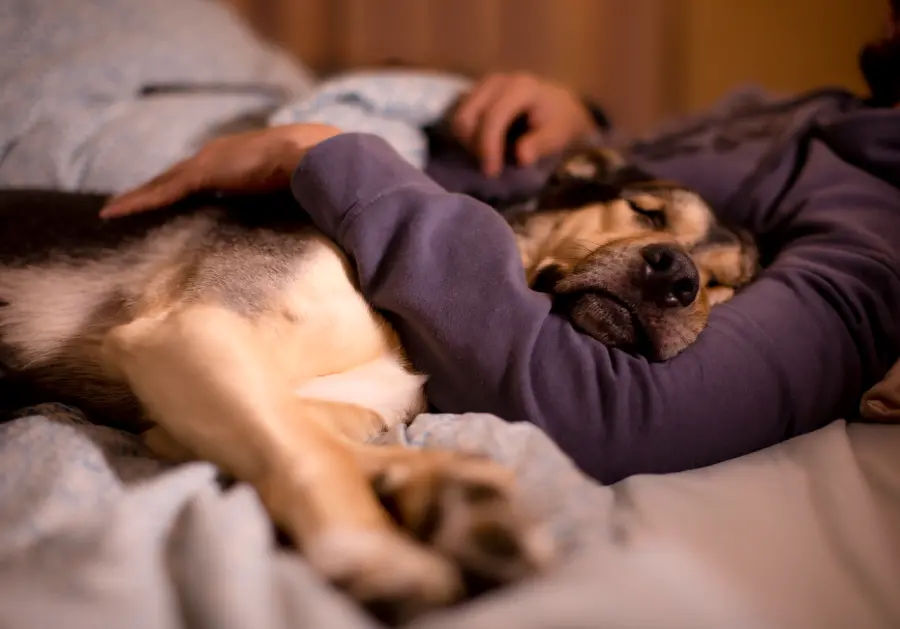
A dog’s desire to sleep beside its owner can be understood as a combination of several factors:
- Attachment: The owner is an important social partner.
- Security: Physical proximity can provide a familiar and predictable environment.
- Warmth and comfort: Sharing a sleeping area can be physically comfortable.
- Social behavior: Dogs naturally spend considerable time resting near members of their social group.
- Routine: If sleeping together has become part of the dog’s daily pattern, the dog may simply expect it.
- Positive reinforcement: If sleeping beside you results in petting, attention, warmth, or access to a comfortable bed, the behavior can become strongly established.
Importantly, these explanations can overlap. There is rarely one single reason that applies to every dog.
Dogs Can Form Genuine Attachment to Their Owners
One of the most important findings in canine behavior research is that the relationship between dogs and humans is more complex than simple food dependence.
Research using attachment-based behavioral tests has found evidence that many dogs use their owners as a “secure base.” In experimental settings, dogs may explore and interact with their environment more when their owner is present than when the owner is absent.
This concept helps explain why a dog may voluntarily choose to sleep near its owner.
For a dog, the owner’s presence can provide a familiar social environment. The dog does not necessarily need constant interaction. Simply knowing that the preferred person is nearby may be reassuring.
This distinction is important:
Attachment does not automatically mean dependence.
A securely attached dog can seek proximity to its owner and still explore, play, rest independently, and tolerate normal periods of separation.
Why Does My Dog Choose My Bed Instead of Its Own?
There are several practical reasons.
1. Your Bed Is Comfortable
Human mattresses, blankets, pillows, and temperature-controlled rooms can be considerably more comfortable than a basic dog bed.
Dogs are highly responsive to environmental comfort. If your bed is warm, soft, quiet, and familiar, choosing it is not mysterious.
From the dog’s perspective, the decision may be very simple:
“This is the most comfortable sleeping location available.”
2. You Provide a Familiar Scent
Dogs have an extraordinary sense of smell. Your bedding carries your scent, and familiar smells can be part of the dog’s normal social environment.
For an attached dog, your scent and physical presence may be associated with safety and predictability.
3. Sleeping Together Has Become a Routine
Dogs are excellent at learning predictable patterns.
If the household routine is:
Dinner → walk → relaxation → bedroom → owner gets into bed → dog joins
the dog may eventually anticipate the entire sequence.
This is not necessarily evidence of emotional insecurity. It may simply be a well-established routine.
4. Your Presence May Help the Dog Relax
Research investigating canine sleep has provided particularly interesting evidence.
A 2022 study found an association between attachment to owners and differences in dogs’ sleep EEG characteristics when dogs slept in an unfamiliar environment with their owners. The researchers suggested that the owner’s presence may function as a safe haven during an unfamiliar or unusual situation.
More recently, a small 2025 polysomnography study directly compared dogs sleeping with their owners versus with a friendly unfamiliar person. The researchers reported differences in sleep structure, including reduced sleep efficiency and less non-REM sleep when owners were absent. However, the study involved only nine dogs, so its findings should be interpreted as evidence about this particular sample rather than proof that every dog sleeps better beside its owner.
That distinction is important for responsible pet-health information.
Does Sleeping with You Mean Your Dog Is Not Independent?
No.
This is one of the most common misconceptions about canine attachment.
A dog can be strongly attached to its owner while also developing healthy independence.
Think of independence and attachment as two different dimensions.
| Behavior | What it may indicate |
|---|---|
| Sleeps beside you | Social preference or comfort |
| Follows you around the house | Social attachment, habit, or learned behavior |
| Plays independently | Ability to function without constant interaction |
| Sleeps in another room sometimes | Normal flexibility |
| Can remain calm when you leave | Healthy tolerance of separation |
| Panics when you leave | Possible separation-related problem |
| Destroys doors when alone | Possible separation distress |
| Constantly vocalizes after departure | Possible anxiety or distress |
The key is how flexible the dog is.
A dog that chooses to sleep with you but can comfortably sleep elsewhere is demonstrating a very different pattern from a dog that becomes distressed whenever physical contact is interrupted.
Sleeping Together vs. Separation Anxiety
This distinction deserves special attention.
Normal attachment
A normally attached dog may:
- follow you around;
- sleep near you;
- greet you enthusiastically;
- prefer your company;
- occasionally choose your bed;
- relax independently;
- remain comfortable when you leave.
Possible separation-related distress
A dog with separation distress may:
- become anxious before you leave;
- pace or repeatedly scan the environment;
- bark or howl after departure;
- scratch doors or windows;
- destroy objects associated with escape or reunion;
- urinate or defecate despite otherwise appropriate house training;
- drool excessively;
- remain unable to settle;
- show exaggerated distress when you return.
Veterinary behavioral guidance emphasizes that close attachment behaviors, such as following family members around the home, do not by themselves indicate that a dog has separation anxiety. Diagnosis requires looking at the complete behavioral pattern and ruling out other explanations.
A camera recording can be particularly useful because many separation-related behaviors occur after the owner leaves and therefore cannot be observed directly.
Why Some Dogs Become More Attached Than Others
Individual dogs differ substantially.
Factors that may influence the relationship include:
Early social experience
Puppies learn how to interact with humans, animals, environments, and separation through repeated experiences.
Temperament
Some dogs naturally seek more social contact, while others are more comfortable resting independently.
Life history
A dog’s previous experiences can influence how it responds to unfamiliar environments and people. Research has found differences in owner-related behavior among dogs with different backgrounds, including former shelter dogs.
Household routine
A dog whose owner works from home may develop a different daily pattern from one whose owner is away for eight hours.
Reinforcement
If climbing onto the bed consistently produces affection, conversation, treats, or attention, the behavior becomes more rewarding.
Relationship quality
Research has also found associations between human caregiving style and aspects of canine social behavior and problem-solving. One study reported that dogs whose owners combined high responsiveness with clear expectations showed different behavioral patterns from dogs whose owners were less responsive or had different interaction styles.
These findings do not mean that an owner’s personality single-handedly determines a dog’s behavior. Genetics, temperament, environment, learning history, and health all contribute.
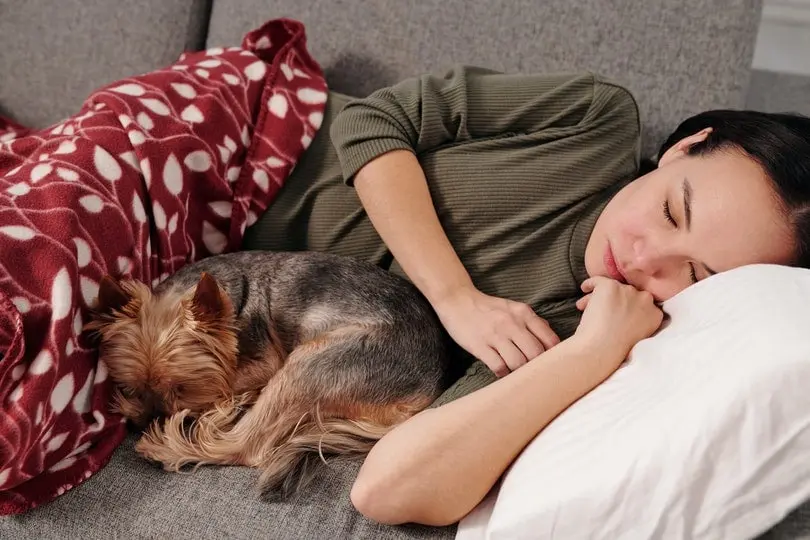
Is It Healthy to Let Your Dog Sleep in Your Bed?
For many healthy households, sleeping together can be perfectly reasonable.
Veterinary guidance generally focuses less on a universal “yes or no” rule and more on the individual dog’s behavior, health, and the owner’s circumstances. Dogs that do not have relevant health or behavioral problems may be able to sleep with their owners without difficulty.
However, several situations deserve caution.
1. Resource Guarding
Some dogs become possessive of beds, furniture, or people.
Warning signs include:
- stiffening when approached;
- growling;
- snapping;
- guarding a particular sleeping position;
- preventing another person or animal from approaching.
A dog displaying these behaviors should not simply be allowed continued unrestricted access to the bed while the problem is ignored. Veterinary or qualified behavior support may be appropriate.
2. Startle Responses
Dogs can react defensively when suddenly awakened.
If a dog consistently growls, snaps, or bites when touched during sleep, allowing unrestricted bed-sharing may increase risk.
3. Human Sleep Quality
Even when the arrangement is emotionally positive, the dog may move around, snore, scratch, or wake the owner repeatedly.
Good human sleep matters too.
4. Health Considerations
Owners with specific health vulnerabilities, allergies, or immune-related concerns may need individualized advice about close animal contact and bedroom hygiene.
How to Encourage Healthy Independence Without Rejecting Your Dog
If your goal is to maintain a close bond while teaching your dog to sleep independently, the objective should not be to suddenly push the dog away.
Instead, create another location that is genuinely rewarding.
Step 1: Create an attractive sleeping area
Use a comfortable dog bed in a quiet location.
Step 2: Reward voluntary use
When your dog chooses the bed, calmly reinforce the behavior.
Step 3: Build positive associations
Offer an appropriate chew, food puzzle, or other enrichment activity there.
Step 4: Practice independence during the day
Independence is easier to teach when the dog is relaxed rather than already anxious at bedtime.
Step 5: Keep departures predictable
If the dog shows distress when you leave, avoid simply forcing longer and longer periods of isolation. Veterinary behavior guidance recommends carefully graduated departure training for separation distress, with absences kept below the dog’s anxiety threshold.
Step 6: Watch the dog’s actual behavior
Don’t judge progress simply by whether the dog stays in its bed.
The more meaningful question is:
Can the dog remain relaxed when you are not physically beside it?
A Simple Test: Attachment or Anxiety?
You can think about your dog’s behavior using three questions.
Question 1: Does my dog choose me?
If your dog prefers sleeping beside you, that is consistent with social attachment.
Question 2: Can my dog function without me?
If your dog can eat, play, rest, explore, and sleep independently, that suggests healthy flexibility.
Question 3: What happens when I leave?
This is often the most informative question.
If your dog simply watches you leave and eventually settles, sleeping beside you is unlikely to be evidence of separation anxiety by itself.
If your dog becomes increasingly distressed, vocalizes continuously, destroys exit points, eliminates indoors, or cannot settle, further behavioral assessment is warranted.
Why Your Dog May Follow You Everywhere but Still Be Independent
A common scenario illustrates the difference.
Imagine a dog that follows its owner from the kitchen to the living room, lies beside the owner while watching television, follows them upstairs, and sleeps on the bed.
During the day, however, the owner can leave for several hours and the dog calmly sleeps on its own.
That dog may simply have a strong social preference for its owner.
Now consider another dog that follows the owner everywhere and becomes distressed whenever the owner disappears behind a door. When the owner leaves the house, the dog immediately begins barking, pacing, scratching at doors, and cannot settle.
The second pattern warrants much greater attention because the issue is not simply proximity-seeking. It involves distress associated with separation.
This behavioral distinction is much more useful than labeling either dog “dependent.”
Can Sleeping with Your Dog Strengthen the Bond?
Shared sleep may become one part of a broader human-dog relationship, but it should not be viewed as a treatment or guaranteed method for strengthening attachment.
The evidence clearly supports the existence of meaningful dog-human attachment relationships. Research has demonstrated owner-specific secure-base effects, and other work has shown that dog-human attachment can have measurable behavioral and physiological correlates.
But attachment develops through many repeated interactions, including:
- predictable caregiving;
- appropriate exercise;
- play;
- training;
- positive reinforcement;
- social interaction;
- access to safe resting spaces;
- reliable responses to the dog’s needs.
Sleeping together is only one possible component.
When Should a Veterinarian or Behavior Professional Be Consulted?
Consider professional advice when your dog’s sleeping behavior is accompanied by:
- sudden changes in nighttime behavior;
- inability to settle;
- repeated nighttime vocalization;
- aggression when approached while resting;
- destructive behavior when separated;
- excessive panting or pacing;
- repeated accidents in the house;
- significant changes in appetite or activity;
- apparent pain or discomfort;
- confusion or unusual nighttime behavior, particularly in an older dog.
A sudden behavioral change should not automatically be interpreted as an attachment issue. Pain, illness, sensory changes, environmental stress, and other medical or behavioral conditions can alter sleep and nighttime behavior.
FAQs
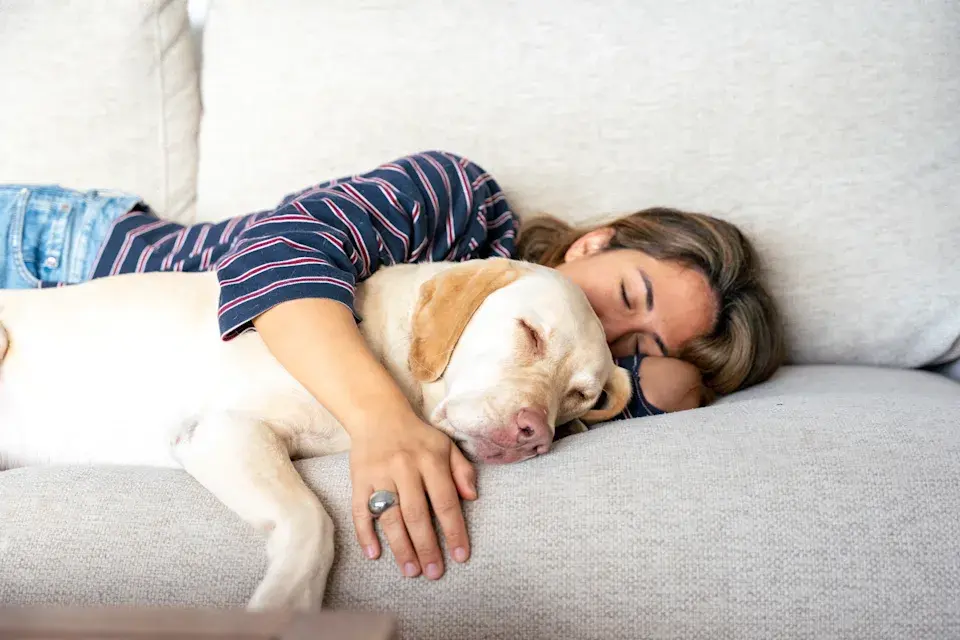
Why dogs want to sleep with their owners?
Dogs want to sleep with their owners because of social attachment, comfort, warmth, familiarity, and routine. Dogs are social animals, so sleeping close to a trusted person can be a normal expression of companionship and security.
Does sleeping with owners mean dogs have separation anxiety?
No. Dogs sleeping with owners does not automatically indicate separation anxiety. A dog can enjoy sleeping beside its owner and still be independent. Separation anxiety is more strongly associated with distress when the owner leaves, such as persistent barking, pacing, destruction, or inability to settle.
Is sleeping with your dog a sign of strong dog attachment to owners?
It can be one indication of dog attachment to owners, particularly when the dog voluntarily seeks proximity and relaxes around its caregiver. However, sleeping together alone cannot determine whether a dog has a secure or insecure attachment.
How can I help my dog develop independence while maintaining attachment?
To support dog independence and attachment, provide a comfortable sleeping area, reward calm independent behavior, introduce short periods of separation gradually, and maintain predictable daily routines. Healthy independence means your dog can relax without constant physical contact.
Should dogs sleeping with owners be allowed every night?
For many households, dogs sleeping with owners can be perfectly acceptable if both the dog and owner sleep comfortably and safely. Owners should reconsider unrestricted bed access if the dog shows resource guarding, aggression when disturbed, significant sleep disruption, or separation-related behavioral problems.
The Bottom Line: Why Does My Dog Want to Sleep with Me?
Most dogs that want to sleep with their owners are expressing a combination of social attachment, familiarity, comfort, warmth, routine, and learned preference—not necessarily unhealthy dependence.
Scientific research supports the idea that dogs can form meaningful attachment relationships with human caregivers and can use their owners as a source of security in unfamiliar or challenging situations.
The important distinction is between preference and distress.
A dog that says, in effect, “I prefer sleeping beside you” may simply be demonstrating a healthy social bond.
A dog that communicates, “I cannot cope when you are gone,” may have a separation-related problem that deserves professional assessment.
So if your dog curls up beside you every night, there is usually no need to interpret the behavior as a failure of independence. Instead, look at the whole behavioral picture. A securely attached dog can love being close to you and still be capable of being alone.
References
- Carreiro, C., Reicher, V., Kis, A., & Gácsi, M. (2022). Attachment towards the Owner Is Associated with Spontaneous Sleep EEG Parameters in Family Dogs. Animals, 12(7), 895. Read the research paper
- Merck Veterinary Manual — Behavior Problems of Dogs. Veterinary reference covering separation distress, clinical signs, environmental management, and behavioral considerations.
Read the veterinary reference - Siniscalchi, M., Stipo, C., & Quaranta, A. (2013). “Like Owner, Like Dog”: Correlation between the Owner’s Attachment Profile and the Owner-Dog Bond. PLOS ONE, 8(10), e78455.
Read the research paper