




Yes, dogs can watch TV, and some dogs find moving images, animals, and sounds interesting or stimulating. However, television should be treated as optional enrichment rather than a substitute for exercise, play, training, sniffing, or social interaction. Your dog’s individual response should determine whether screen time is appropriate.
DoggyZine.com
Yes, watching TV with your dog can be perfectly fine—and for some dogs, screen content may provide mild mental stimulation or enrichment. However, television should not replace exercise, sniffing, play, training, or social interaction. Whether a dog benefits from watching a screen depends largely on the individual dog’s temperament, vision, age, breed tendencies, and the type of images and sounds being shown.
Dogs do not experience television exactly as humans do. They can detect movement, recognize certain visual patterns, respond to sounds, and in some circumstances distinguish familiar animals or objects on a screen. Research also suggests that dogs can process some two-dimensional images meaningfully, although they do not automatically interpret every screen image as equivalent to a real three-dimensional object.
Table of Contents
Can Dogs Actually See What Is Happening on TV?
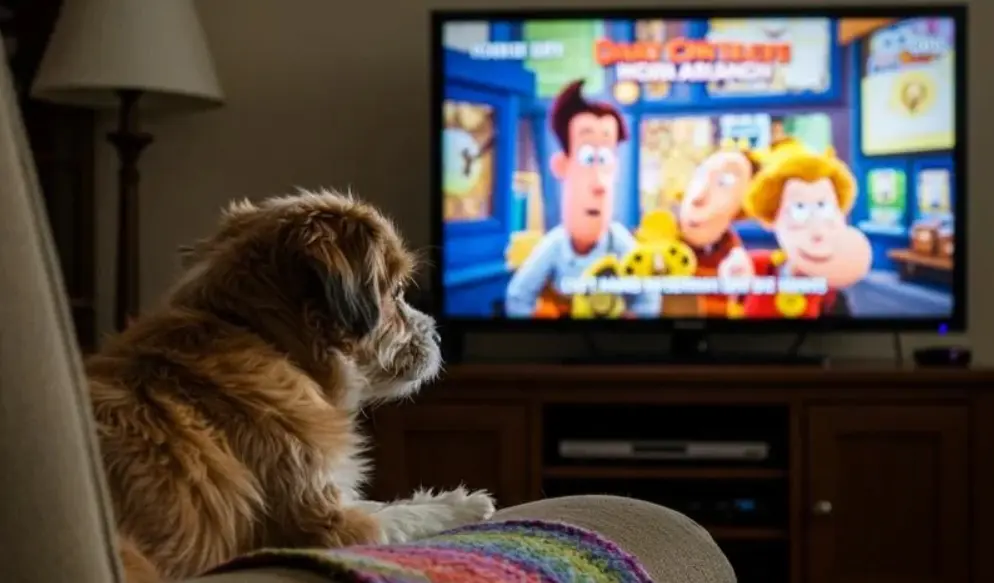
Dogs can see television images, but their visual experience differs from ours.
Dogs are generally dichromatic, meaning their color vision is based primarily on two types of cone photoreceptors rather than the three used by most humans. They are particularly better at distinguishing blue and yellow ranges than red and green. Dogs also have visual adaptations that help them detect movement and function in lower-light conditions.
This matters because television depends heavily on rapidly changing visual information.
Dogs have a higher flicker-fusion threshold than humans. In practical terms, some screens that appear continuous to a person may be perceived differently by a dog, particularly depending on the display technology, refresh rate, viewing distance, and the dog’s visual system.
That does not mean a dog is simply watching a “flickering box.” Research indicates that dogs can attend to meaningful information in digital images and videos.
For example, eye-tracking research has shown that dogs look at informative regions of digital images, including images of dogs, people, and objects.
What Does a TV Screen Mean to a Dog?
The most accurate answer is: it depends on the dog and the content.
A television is not necessarily understood by a dog as a miniature version of the real world. Dogs may respond to combinations of:
- Movement
- Shape
- Contrast
- Familiar animals
- Human figures
- Vocalizations
- Barking
- High-pitched sounds
- Rapid motion
- Other attention-grabbing sounds
Research into canine perception of video suggests that dogs can process the content of familiar scenes rather than responding only to movement. In one study, dogs responded differently to normally oriented videos of humans compared with unusual presentations, suggesting that familiarity with the depicted scene influences how they process artificial visual information.
At the same time, neuroscience research indicates that dogs do not automatically generalize between two-dimensional and three-dimensional objects. In other words, seeing an object on a screen does not necessarily mean the dog represents it mentally in exactly the same way it represents a physical object.
This distinction helps explain why one dog may bark enthusiastically at a dog on television while another barely looks up.
Do Dogs Recognize Other Dogs on TV?
Evidence suggests that dogs can visually recognize other dogs.
Previous research has demonstrated that dogs can distinguish photographs of natural stimuli and categorize images of dogs. Other work has found that dogs can process images of dogs and humans as meaningful visual stimuli.
A 2025 study specifically examining television viewing in companion dogs found that the type of stimulus shown on television was associated with different viewing behaviors. The study involved 453 owner responses and found that dogs’ television-viewing behavior was related to both the types of objects shown and the dog’s behavioral response, including following the screen or remaining stationary. Temperament characteristics such as excitement and negative reactivity also helped explain differences between dogs.
So when your dog suddenly notices another dog on television, the reaction is not necessarily random.
The dog may be responding to recognizable visual and auditory cues.
Why Do Some Dogs Love Watching TV?
Dogs vary considerably in their response to screens.
A large owner survey published in 2024 found that 86% of respondents said their dogs watched screen content. Among dogs reported to engage with screens, 78% approached the screen and 76% vocalized. Animal content was particularly engaging, with dogs being the most popular animal stimulus.
Several factors may influence this behavior.
1. Movement
Fast-moving objects can capture canine attention.
A running animal, bouncing ball, flying bird, or rapidly moving object may be much more interesting to a dog than a person sitting still and talking.
2. Sound
Television is not purely a visual experience for dogs.
Barking, squeaking, animal noises, high-pitched sounds, doorbells, and sudden noises can trigger attention or excitement.
This is one reason a dog may ignore a documentary for 40 minutes and suddenly sprint toward the television when a bird appears.
3. Individual temperament
A dog’s personality matters.
Some dogs naturally investigate novel stimuli. Others are more cautious or easily startled.
The 2025 study of companion-dog television viewing found that temperament measures helped explain differences in dogs’ responses to screen content.
4. Breed-related tendencies
Breed history can also influence what captures a dog’s attention.
A dog selected historically for visual pursuit may show considerable interest in moving objects, while a scent-oriented dog may receive relatively little useful information from a screen because television cannot reproduce odor.
Breed should not be treated as a prediction of individual behavior, however. Two dogs of the same breed can respond very differently.
Is Watching TV Good for Dogs?
It can be, but only as a form of supplemental enrichment.
Television may provide novelty, visual stimulation, or interesting sounds. Research has even suggested that engagement with television could have potential enrichment applications, including for dogs in shelter environments.
However, watching television is not equivalent to meeting a dog’s broader behavioral needs.
A screen cannot replace:
- Daily walks
- Sniffing and exploration
- Physical exercise
- Training
- Interactive play
- Chewing opportunities
- Food-based enrichment
- Social interaction
- Rest and predictable routines
A dog that spends an hour watching birds on television has not necessarily received the same benefits as a dog that spends an hour exploring a safe outdoor environment.
For most dogs, television is best considered an optional enrichment activity, not a primary activity.

Can TV Help a Dog When Left Alone?
Some owners leave television or videos playing when they leave home.
This may provide background sound or occasional visual stimulation, but it should not automatically be considered a treatment for separation anxiety.
If a dog becomes distressed when left alone—especially through persistent barking, destructive behavior, escape attempts, pacing, elimination, or other signs of distress—the underlying problem deserves proper behavioral assessment.
Simply turning on a television may mask some environmental sounds without addressing the cause.
A better approach can involve a structured behavior plan, appropriate exercise, environmental enrichment, gradual alone-time training, and professional veterinary or behavioral guidance when necessary.
What Kind of TV Shows Do Dogs Prefer?
There is no single program that every dog will enjoy.
However, dogs often show more interest in content containing animals or movement than in conventional human-centered programming.
The 2024 survey found that animal content was particularly engaging among dogs that interacted with screens.
You can experiment with:
Animal documentaries
Birds, dogs, squirrels, rabbits, and other moving animals may attract attention.
Dog-focused videos
Some dogs respond to recordings containing other dogs, barking, or familiar canine behaviors.
Nature footage
Moving wildlife can provide visual stimulation.
Calm background programming
Some dogs may simply tolerate or ignore quiet television, which is completely normal.
The goal should not be to make your dog watch television. The goal is to determine whether the content is neutral, enjoyable, or stressful for your individual dog.
How to Tell Whether Your Dog Enjoys TV
Do not assume that staring at a screen automatically means your dog is having fun.
Look at the entire body and behavioral pattern.
Signs of comfortable engagement
Your dog may:
- Watch the screen briefly and then relax
- Approach voluntarily
- Sit or lie down comfortably
- Look away without distress
- Return to the screen occasionally
- Maintain a relaxed body posture
- Respond to interesting scenes and then settle
Signs of excessive arousal or stress
Be more cautious if your dog:
- Barks continuously
- Lunges at the television
- Scratches or bites the screen
- Paces repeatedly
- Cannot disengage
- Whines persistently
- Shows intense fixation
- Becomes agitated when animals disappear
- Displays other stress-related behaviors
A dog that is intensely focused on the screen is not necessarily enjoying it.
This is an important distinction between engagement and welfare.
Should You Let Your Dog Bark at the TV?
Occasional barking is not necessarily a problem.
However, repeated barking or escalating arousal is a reason to change the viewing setup.
If your dog repeatedly reacts to animals on television, try:
- Lowering the volume.
- Choosing slower-moving content.
- Increasing the distance from the screen.
- Turning off content that triggers intense reactions.
- Rewarding calm behavior.
- Giving the dog an opportunity to disengage.
If your dog cannot settle even after the stimulus is removed, discuss the behavior with a veterinarian or qualified canine behavior professional.
Can Watching TV Hurt a Dog’s Eyes?
For a healthy dog, ordinary television viewing is not generally considered a substitute for a damaging visual exposure simply because the dog watches the screen.
The more relevant concern is behavioral response and individual health, rather than assuming that television itself is inherently harmful.
Dogs with known eye disease or impaired vision should be managed according to veterinary advice.
It is also sensible to avoid forcing a dog to sit extremely close to a bright screen for long periods.
A comfortable viewing distance and the ability to move away are simple precautions.
Should You Leave the TV On for Your Dog All Day?
Usually, there is no compelling reason to keep a dog continuously engaged with television.
Constant exposure may become less interesting over time, and a continuously stimulating environment is not necessarily better than a quiet environment.
The American Kennel Club notes that dogs’ interest in television varies according to factors such as personality and breed characteristics, and that dogs may become accustomed to continuously playing television content.
For many dogs, a predictable combination of rest, sleep, environmental exploration, play, training, and occasional novelty is more appropriate than nonstop screen exposure.
A Practical 20-Minute TV Test for Your Dog
If you are unsure whether your dog benefits from television, try a simple observation test.
Step 1: Establish a baseline
Let your dog relax normally for several minutes.
Observe posture, breathing, activity level, and behavior.
Step 2: Choose neutral content
Start with a calm program containing minimal sudden movement or loud sounds.
Step 3: Introduce animal content
Try a short segment featuring dogs or other animals.
Step 4: Observe without encouraging the dog
Do not point at the screen, call the dog’s name repeatedly, or reward every reaction.
You want to see the dog’s spontaneous response.
Step 5: Look for recovery
After turning the television off, see whether your dog quickly returns to normal behavior.
Step 6: Adjust accordingly
If the dog remains calm and occasionally watches, television can be treated as optional enrichment.
If the dog becomes highly aroused or distressed, choose different content or stop using the screen.
TV Watching vs. Real-World Enrichment
| Activity | Main type of stimulation | Can it replace a walk? |
|---|---|---|
| Watching TV | Visual + auditory | No |
| Watching animal videos | Visual + auditory | No |
| Sniffing outdoors | Olfactory + physical | No, but highly valuable |
| Interactive play | Physical + cognitive | No |
| Training | Cognitive + social | No |
| Food puzzle | Cognitive + olfactory | No |
| Free exploration | Physical + sensory | No |
The key point is that different forms of enrichment serve different purposes.
Television can add variety, but it does not provide the multisensory experience of the real world.
What About Dogs That Ignore TV?
That is completely normal.
Some dogs simply have little interest in screens.
A dog may prefer:
- Smelling outdoors
- Chewing
- Playing with toys
- Watching a window
- Interacting with people
- Sleeping
Lack of interest in television does not mean the dog is bored or less intelligent.
In fact, a dog’s indifference to a screen may simply reflect that television provides fewer useful sensory cues than the real environment.
FAQs
Do dogs understand TV?
Dogs can respond meaningfully to visual and auditory information on screens, but they do not necessarily interpret two-dimensional images exactly as humans do. Research suggests that familiarity with the depicted scene and the dog’s previous experience can influence how screen content is processed.
Do dogs enjoy watching television?
Some dogs appear to enjoy or actively engage with television, while others show little interest. Survey research indicates substantial individual variation, with animal content being particularly engaging for many dogs that watch screens.
What TV shows are best for dogs?
There is no universally best program. Many dogs respond to animal footage, movement, and certain sounds. Choose content that produces calm engagement rather than excessive barking, fixation, or distress.
Can TV help dogs with separation anxiety?
Television may provide background stimulation, but it should not be considered a treatment for separation anxiety. Persistent distress when alone should be evaluated as a behavioral problem and addressed with an appropriate management and training plan.
Why does my dog bark at animals on TV?
Movement, recognizable animal shapes, barking, and other sounds can attract a dog’s attention. Some dogs are particularly responsive to fast-moving visual stimuli. If barking becomes intense or difficult to interrupt, switch to calmer content or stop the activity.
The Bottom Line: Should You Watch TV With Your Dog?
Yes, you can watch TV with your dog if your dog remains comfortable and the activity is treated as optional enrichment rather than a substitute for exercise or interaction.
Dogs can perceive meaningful visual and auditory information from screens, and research shows that some dogs actively engage with television content. Their responses vary according to temperament, age, visual ability, breed-related tendencies, and the type of material being shown.
The best test is your dog’s behavior.
If your dog calmly watches a nature documentary for a few minutes and then settles beside you, there is little reason to be concerned. If the dog repeatedly barks, lunges, becomes agitated, or cannot disengage, the content is probably providing more arousal than useful enrichment.
Ultimately, the value of television for a dog is not determined by how long the dog watches it, but by what the dog experiences and how the dog responds.
A screen can be an interesting addition to a dog’s environment. It should never become a replacement for the things dogs need most: movement, exploration, play, training, social connection, and adequate rest.
Resources
- Scientific Reports — Characterizing TV viewing habits in companion dogs (2025)




